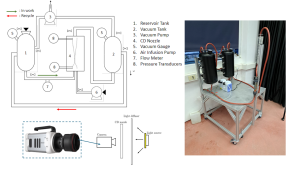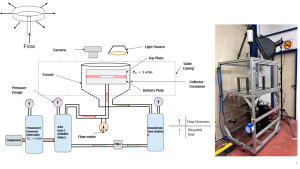


Our lab is equipped with state-of-the-art diagnostic tools and setups, and equipment for turbulent boundary layer and cavitation research.
Instrumentation includes:
- Plasma actuators
- Hotwire anemometry system
- multi-axis load sensor
- multi-channel pressure scanner (128 channels)
- PCB sensors for covering a wide range of frequencies up to 250 kHz
- Setra Pressure Sensors for subatmospheric conditions.
- High-speed/high-resolution imaging techniques (Stereo PIV system; Schlieren shadowgraph). In particular, we have two stereo PIV systems:
-
- High-resolution PIV system that utilizes Nd: YAG double-cavity laser with pulse energy of 200 mJ in conjunction with two high-resolution cameras (5312 x 3024 pixel) to acquire the velocity field at frequencies of 45.6 Hz at full resolution.
- Time-Resolved PIV system that utilizes an Nd:YLF dual cavity pumped solid-state, high repetition rate laser that has the capability of providing 30 mJ/pulse at a repetition rate of 10 kHz in conjunction with two high-speed imaging cameras (1024 x 1024 pixels at 16,000 fps) and third camera (2560 × 1664 pixels at 9,350 fps).
Transitional and turbulent boundary layers research setups:
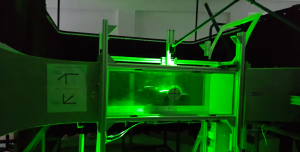
- Modular test section (0.5 x 0.5 m^2)in variable-speed (up to 50 m/s), low turbulence (0.1%) closed loop wind tunnel. The test sections are designed to be flexible in their use, allowing work on several projects in parallel. The test section is designed to
provide flexible optical access for laser-based flow diagnostics such as PIV, and surface oil flow visualizations. - In addition, our lab has access to the facilities of the Technion Wind Tunnel Complex of the Faculty of Aerospace Engineering, which allows us to conduct wind tunnel studies at a wide range of flow conditions.

Cavitation and bubble dynamics research setups:
The lab processes a state-of-the-art cavitation and bubble dynamics setups will be constructed to understand complex cavitation mechanisms involving bubble dynamics.
- A vacuum-driven-blowdown CD-nozzle setup.
- High-pressure radial flow setup of a thin lubricating film between two overlying disks.
In all setups (such as the two examples above), the high-speed imaging is obtained in conjunction with the following measurements: flow rate and dissolved gas content measurements; dynamical (unsteady) pressure measurements to fully quantify the spatial-temporal behavior of cavitation collapse events and traveling shock front magnitudes and time-mean pressure profiles will be obtained using static pressure transducer capable of measuring pressure sub-atmospheric conditions. These measurements provide a full characterization of the cavitation behavior that would be used to improve our understanding of the bubble dynamics of non-spherical cavities and bubbly shock emission generation and evolution mechanisms in multi-component cavitating liquids.