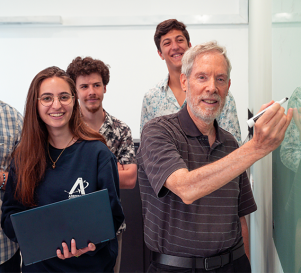



הפקולטה להנדסת אווירונוטיקה וחלל בטכניון ע"ש סטיבן ב. קליין היא מרכז אקדמי ברמה עולמית לאוירונוטיקה ואסטרונאוטיקה, המוקדש ליצירה, הרחבה והפצה של רעיונות וידע במדעי התעופה והחלל.
Nour Aldeen Nasrallah | Metal-organic frameworks (MOFs) are nanoporous materials with strong potential for sorption-based atmospheric water harvesting, owing to their exceptionally high surface areas (~5,000 m²/g) and easy regeneration at low temperatures (~70 °C). However, their practical implementation is limited by slow heat and mass transport, poor sorbent utilization, and the difficulty of integrating MOF nanopowders into scalable macroscopic thermofluid systems.
Shavit Attar | This study demonstrates closed-loop control of the shock train leading-edge location in a dual-mode scramjet combustor using fuel-injection distribution as the control input. Experiments were performed in a direct-connect, cavity-stabilized combustor with distributed ethylene injection.
Avia Rosenfeld | Nanostructured thermites offer unique opportunities for controlling ignition and energy release through engineered material architectures. This seminar presents the fabrication and characterization of Al/SiO₂ multilayer nanothermites produced by physical vapor deposition and examines their thermal and laser-induced ignition behavior.
Nour Aldeen Nasrallah | Metal-organic frameworks (MOFs) are nanoporous materials with strong potential for sorption-based atmospheric water harvesting, owing to their exceptionally high surface areas (~5,000 m²/g) and easy regeneration at low temperatures (~70 °C). However, their practical implementation is limited by slow heat and mass transport, poor sorbent utilization, and the difficulty of integrating MOF nanopowders into scalable macroscopic thermofluid systems.
Shavit Attar | This study demonstrates closed-loop control of the shock train leading-edge location in a dual-mode scramjet combustor using fuel-injection distribution as the control input. Experiments were performed in a direct-connect, cavity-stabilized combustor with distributed ethylene injection.
Saar Levi | Hypergolic propellants are defined by their ability to ignite immediately upon contact, resulting in rapid exothermic reactions occurring without the need for an external ignition source. In hybrid rocket engines, this spontaneous reaction simplifies thruster management, reduces system mass, and enables engine re-ignition.
Tamir Gazit | A data-driven methodology is proposed to identify linear unsteady aerodynamic reduced-order models (ROMs) for flexible structures. Constrained gradient-based optimization extracts aerodynamic stiffness, damping, and time-domain convolution kernels directly from input-output data.
Omer Wexler | This work is towards an M.Sc. degree under the supervision of Assoc. Prof. Moshe Idan, The Stephen B. Klein Faculty of Aerospace Engineering, Technion
Avia Rosenfeld | Nanostructured thermites offer unique opportunities for controlling ignition and energy release through engineered material architectures. This seminar presents the fabrication and characterization of Al/SiO₂ multilayer nanothermites produced by physical vapor deposition and examines their thermal and laser-induced ignition behavior.
Nour Aldeen Nasrallah | Metal-organic frameworks (MOFs) are nanoporous materials with strong potential for sorption-based atmospheric water harvesting, owing to their exceptionally high surface areas (~5,000 m²/g) and easy regeneration at low temperatures (~70 °C). However, their practical implementation is limited by slow heat and mass transport, poor sorbent utilization, and the difficulty of integrating MOF nanopowders into scalable macroscopic thermofluid systems.
Shavit Attar | This study demonstrates closed-loop control of the shock train leading-edge location in a dual-mode scramjet combustor using fuel-injection distribution as the control input. Experiments were performed in a direct-connect, cavity-stabilized combustor with distributed ethylene injection.
Saar Levi | Hypergolic propellants are defined by their ability to ignite immediately upon contact, resulting in rapid exothermic reactions occurring without the need for an external ignition source. In hybrid rocket engines, this spontaneous reaction simplifies thruster management, reduces system mass, and enables engine re-ignition.
Tamir Gazit | A data-driven methodology is proposed to identify linear unsteady aerodynamic reduced-order models (ROMs) for flexible structures. Constrained gradient-based optimization extracts aerodynamic stiffness, damping, and time-domain convolution kernels directly from input-output data.
Omer Wexler | This work is towards an M.Sc. degree under the supervision of Assoc. Prof. Moshe Idan, The Stephen B. Klein Faculty of Aerospace Engineering, Technion