
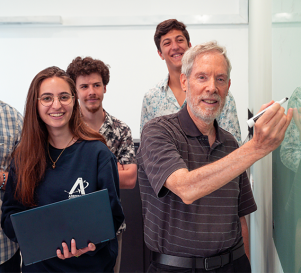
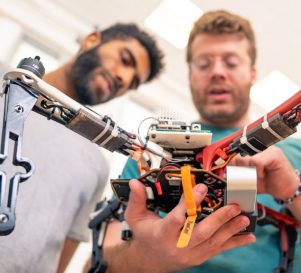


הפקולטה להנדסת אווירונוטיקה וחלל בטכניון ע"ש סטיבן ב. קליין היא מרכז אקדמי ברמה עולמית לאוירונוטיקה ואסטרונאוטיקה, המוקדש ליצירה, הרחבה והפצה של רעיונות וידע במדעי התעופה והחלל.
Ido Braun | Modern integrated air-defense systems (IADS) equipped with advanced surface-to-air missiles (SAMs) pose a significant threat to fighter jets conducting strike missions against ground targets. To successfully deliver the munition, the aircraft must satisfy conflicting operational objectives.
Avia Rosenfeld | Nanostructured thermites offer unique opportunities for controlling ignition and energy release through engineered material architectures. This seminar presents the fabrication and characterization of Al/SiO₂ multilayer nanothermites produced by physical vapor deposition and examines their thermal and laser-induced ignition behavior.
Din Ben Adva | The talk presents two recent studies examining the emergence of corner-flow circulation in confined geometries at highly rarefied conditions, where the characteristic length scale is comparable to the molecular mean free path of the gas.
Prof. Eli Livne | The idea that active control could be used to shape the aeroelastic behavior of deformable aircraft was known to aeroelasticians many years ago. In the late 1960s / early 1970s, with the appearance of “fast enough” actuators and other improvements in control technology’s theory and hardware, active aeroelastic control became feasible.
Ohad Haftka | This talk presents a study of the transmission of sound waves through periodically slitted walls in regimes where the characteristic aperture size and acoustic wavelength are comparable to the molecular mean free path of the gas. The acoustic field is generated by small-amplitude normal oscillations of a vibrating wall located upstream of the perforated plate.
Elbit invites you to special a Spotlight Day where you can get to know the company and its diverse activities, explore career opportunities, and meet Elbit's leading professional managers.
Aharon Renick | Early detection of simulation inaccuracies is critical in system development for increasing result certainty, focusing physical experimentation, and avoiding incorrect conclusions about system performance. This research develops a quantitative methodology to detect "unknown uncertainties“ or “unknown unknowns” within system simulations, in the presence of "known uncertainties“ or “known unknown”.
Ido Braun | Modern integrated air-defense systems (IADS) equipped with advanced surface-to-air missiles (SAMs) pose a significant threat to fighter jets conducting strike missions against ground targets. To successfully deliver the munition, the aircraft must satisfy conflicting operational objectives.
Avia Rosenfeld | Nanostructured thermites offer unique opportunities for controlling ignition and energy release through engineered material architectures. This seminar presents the fabrication and characterization of Al/SiO₂ multilayer nanothermites produced by physical vapor deposition and examines their thermal and laser-induced ignition behavior.
Nour Aldeen Nasrallah | Metal-organic frameworks (MOFs) are nanoporous materials with strong potential for sorption-based atmospheric water harvesting, owing to their exceptionally high surface areas (~5,000 m²/g) and easy regeneration at low temperatures (~70 °C). However, their practical implementation is limited by slow heat and mass transport, poor sorbent utilization, and the difficulty of integrating MOF nanopowders into scalable macroscopic thermofluid systems.
Din Ben Adva | The talk presents two recent studies examining the emergence of corner-flow circulation in confined geometries at highly rarefied conditions, where the characteristic length scale is comparable to the molecular mean free path of the gas.
Prof. Eli Livne | The idea that active control could be used to shape the aeroelastic behavior of deformable aircraft was known to aeroelasticians many years ago. In the late 1960s / early 1970s, with the appearance of “fast enough” actuators and other improvements in control technology’s theory and hardware, active aeroelastic control became feasible.
Ohad Haftka | This talk presents a study of the transmission of sound waves through periodically slitted walls in regimes where the characteristic aperture size and acoustic wavelength are comparable to the molecular mean free path of the gas. The acoustic field is generated by small-amplitude normal oscillations of a vibrating wall located upstream of the perforated plate.
Elbit invites you to special a Spotlight Day where you can get to know the company and its diverse activities, explore career opportunities, and meet Elbit's leading professional managers.
Aharon Renick | Early detection of simulation inaccuracies is critical in system development for increasing result certainty, focusing physical experimentation, and avoiding incorrect conclusions about system performance. This research develops a quantitative methodology to detect "unknown uncertainties“ or “unknown unknowns” within system simulations, in the presence of "known uncertainties“ or “known unknown”.
Ido Braun | Modern integrated air-defense systems (IADS) equipped with advanced surface-to-air missiles (SAMs) pose a significant threat to fighter jets conducting strike missions against ground targets. To successfully deliver the munition, the aircraft must satisfy conflicting operational objectives.
Avia Rosenfeld | Nanostructured thermites offer unique opportunities for controlling ignition and energy release through engineered material architectures. This seminar presents the fabrication and characterization of Al/SiO₂ multilayer nanothermites produced by physical vapor deposition and examines their thermal and laser-induced ignition behavior.
Nour Aldeen Nasrallah | Metal-organic frameworks (MOFs) are nanoporous materials with strong potential for sorption-based atmospheric water harvesting, owing to their exceptionally high surface areas (~5,000 m²/g) and easy regeneration at low temperatures (~70 °C). However, their practical implementation is limited by slow heat and mass transport, poor sorbent utilization, and the difficulty of integrating MOF nanopowders into scalable macroscopic thermofluid systems.